

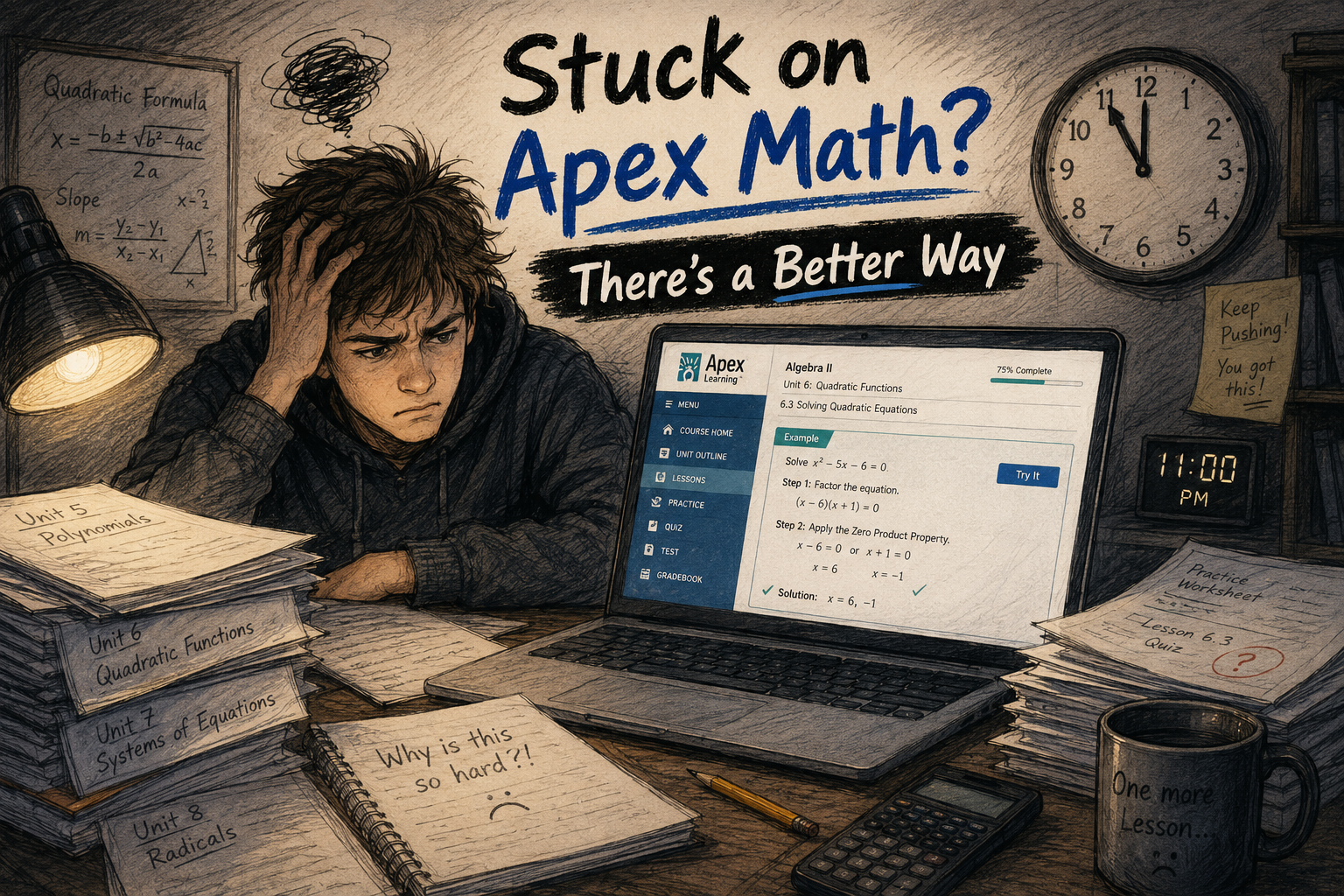
If you’ve ever sat staring at an Apex Learning math module at 11 PM, wondering why the next unit won’t unlock until you finish three more quizzes, you’ve probably typed “apex math answers” into Google at some point. You’re not alone. It’s one of the most searched phrases among high school and online-credit students, and for good reason — Apex Learning’s math courses are notoriously dense, repetitive, and time-consuming.
But before you click on the first “answer key” site that pops up, it’s worth understanding what these resources actually are, how they work, and what you’re risking by using them.
Quick Answer
“Apex math answers” refers to answer keys, solution sets, or shared responses for Apex Learning’s online math courses (Algebra, Geometry, Pre-Calculus, and similar). They’re typically shared through student forums, Quizlet sets, Reddit threads, or dedicated “homework help” sites. While some of these resources are accurate and can help you check your work, many are outdated, incomplete, or flagged by schools as academic dishonesty violations — so using them carries real risk, not just an inconvenience.
What Exactly Is “Apex Math Answers”?
Apex Learning is a digital curriculum provider used by thousands of school districts for credit recovery, online electives, and full virtual schooling. Its math courses walk students through video lessons, guided notes, practice problems, and then a quiz or test at the end of each topic.
“Apex math answers” isn’t one single product — it’s more of an umbrella term for any resource that gives students the correct (or supposedly correct) responses to these quizzes and tests. That includes:
- Crowdsourced answer banks on sites like Quizlet or Brainly
- PDF “answer key” downloads shared in Discord servers or Facebook groups
- YouTube videos walking through specific Apex units step-by-step
- Paid tutoring services that claim to have “the full answer set” for a course
Some of these are genuinely useful study aids. Others are little more than screenshots from a 2019 course version that no longer matches the current question pool — which is a problem I’ll get into shortly.
How It Actually Works
Apex courses pull questions from a question bank, and while the bank is large, it’s not infinite. Over the years, students have compiled and shared the questions and answers they’ve encountered, building up informal databases.
When you search “apex algebra 1 unit 3 quiz answers,” you’re usually landing on one of these crowdsourced collections. The process typically looks like this:
- A student takes the quiz and notes down the questions (sometimes with screenshots).
- They post the question-and-answer pairs to a forum, study site, or social group.
- Other students search for matching questions and copy the listed answer.
- The cycle repeats as Apex periodically updates or rotates its question pools.
This is exactly why accuracy is so inconsistent. Apex updates content more often than people assume, so an answer key from last semester might match maybe 60-70% of your current quiz — if you’re lucky.
Main Features (What People Are Actually Looking For)
When people search for apex math answers, they’re usually after one of these specific things:
- Unit test and quiz answer keys — by far the most common request
- Step-by-step worked solutions — especially for Algebra and Geometry proofs
- Cumulative exam answers — high-stakes, so demand spikes near semester end
- Discussion-based assessment answers — trickier since these often require written responses, not multiple choice
- PDF guides or “cheat sheets” organized by course and unit number
A smaller group of users — often parents helping their kids, or students who genuinely want to learn — are looking for explanations rather than raw answers. That distinction matters a lot for which resource is actually right for you.
Pros and Cons
Pros
- Can save time on legitimately repetitive content. Apex courses do recycle similar problem types across units, so seeing a worked example can speed up your understanding of the next ten nearly identical problems.
- Useful for double-checking your own work. If you’ve already solved a problem and want to verify your answer before submitting, a correct key is genuinely helpful.
- Some videos explain concepts better than Apex’s own lessons. I’ve seen YouTube creators break down quadratic formula applications more clearly in five minutes than Apex does in a 20-minute video module.
- Free options exist. Most answer-sharing communities don’t charge anything, unlike paid “homework help” services.
Cons
- Accuracy is hit or miss. Question banks rotate, and an outdated answer can do more damage than no answer at all — especially if you copy a wrong answer with confidence.
- Academic integrity risk. Many schools use plagiarism and integrity software, and some have started cross-referencing answer patterns against known shared keys.
- No real learning happens. If the goal is credit recovery to eventually pass a state test or move into a harder math class, skipping the learning just pushes the problem down the road.
- Some sites are scammy. A few “answer key” sites exist purely to harvest emails or push you toward paid subscriptions that don’t deliver what they promise.
- Doesn’t help with discussion or essay-based questions, which Apex math courses do include more often than people expect.
Real-World Scenarios
Here’s where it gets practical. Let’s say you’re a junior taking Apex Geometry as a credit recovery course because you failed it during the regular school year. You’re three weeks behind, the semester ends in ten days, and you have 14 modules left.
In this situation, a lot of students lean on answer keys just to get through volume — not because they don’t understand geometry, but because the sheer number of repetitive proofs and quizzes makes finishing on time nearly impossible otherwise. I’ve talked to students in exactly this spot, and the honest truth is: it often works in the short term. They pass the course. But several of them told me they struggled badly in the next math class because the foundational skills never actually stuck.
Compare that to a student using a worked-solutions video just to understand how to set up a system of equations word problem before attempting the rest of the unit on their own. That’s a completely different use case — and a much lower-risk one.
Safety, Privacy, and Legitimacy Analysis
This is the section most people skip, and it’s the one that probably matters most.
Site safety: Many “apex answers” sites are low-quality, ad-heavy pages stuffed with pop-ups. Some require you to “verify you’re human” by completing surveys that lead to sketchy downloads or subscription traps. If a site asks for your phone number or email before showing you a single answer, that’s a red flag.
Academic policy risk: Most school districts that use Apex have academic integrity policies that explicitly cover “use of unauthorized answer keys.” Some learning management systems can flag unusually fast quiz completion times or identical wrong-answer patterns across students, which has led to real disciplinary cases — failed courses, academic probation, even credit revocation in more serious cases.
Legitimacy of the answers themselves: There’s no official, Apex-endorsed answer key floating around publicly — and there never will be, because that would defeat the purpose of the assessment. Anything you find is unofficial, crowdsourced, and unverified. Treat it the way you’d treat a random comment on the internet: maybe true, maybe not, proceed with caution.
Common Problems and Limitations
A few patterns show up again and again with these resources:
- Question order doesn’t match. Apex often randomizes question order per student, so even a correct answer key might be listed in a different sequence than what you see.
- Numbers are randomized too. Many Apex math problems use randomized variables (different coefficients, different numbers in word problems), meaning the method in a shared answer is useful but the final number often isn’t.
- Old course versions. Apex periodically refreshes its curriculum. A “2021 Apex Algebra 2 answers” PDF might be solving completely different problems than your 2026 version.
- Incomplete coverage. Discussion posts, project-based assessments, and performance tasks are rarely included in these answer banks because they require individualized written responses.
Also Read: Classroom 30X
Comparison With Alternatives
If your actual goal is to get through Apex math with less stress — not just to find answers — there are better tools depending on what you need:
| Need | Better Alternative |
|---|---|
| Understanding a concept | Khan Academy (free, matches most Apex topics closely) |
| Step-by-step problem solving | Photomath or a graphing calculator app (Desmos) |
| Checking your own work | Wolfram Alpha for math computation |
| General tutoring | A school’s free tutoring center, or a teacher’s office hours |
| Time management for overdue courses | Talking to your counselor about a realistic completion plan |
None of these carry the same risk as copying answers from an unofficial key, and most of them actually build the skills you’ll need in whatever comes next — another math class, the SAT/ACT, or a college placement test.
An Honest, Practical Take
Here’s my actual opinion after looking into this topic for a while: apex math answer keys exist because Apex’s course design creates a volume problem, not because students are inherently lazy. Nobody wants to do 40 nearly identical slope-intercept problems in one sitting. That’s a legitimate frustration.
But the answer-key route tends to solve the wrong problem. It gets you through this module, but it doesn’t get you any closer to actually understanding slope, factoring, or the Pythagorean theorem — skills that show up again in geometry, physics, standardized tests, and yes, even basic personal finance later in life.
If you’re behind and stressed, the better move is usually a hybrid one: use worked-solution videos to understand the method, then apply that method to your specific (often randomized) numbers yourself. It’s slower than copy-pasting, but it’s the difference between actually finishing the course and finishing the course while quietly falling further behind in math overall.
Final Verdict
Apex math answer resources aren’t inherently “bad” — they’re a symptom of a flawed course design that prioritizes volume over depth. Used carefully, as a way to check work or understand a method, they can genuinely help. Used as a shortcut to avoid learning entirely, they create risk — both academically (integrity violations) and practically (gaps that resurface in future courses).
If you’re going to use any apex math answers resource, treat it as a study aid, verify it against your own reasoning, and be aware that schools are increasingly watching for patterns that suggest unauthorized answer sharing.
FAQs
Q: Are apex math answer keys accurate? A: Some are, many aren’t. Apex frequently rotates question pools and randomizes numbers, so an answer key might match the question type but not the specific numbers or order you see.
Q: Is using apex math answers considered cheating? A: Most schools classify using unauthorized answer keys as an academic integrity violation, similar to plagiarism. Policies vary by district, so check your school’s specific honor code.
Q: Can teachers tell if I used an answer key? A: Many learning management systems track completion times, answer patterns, and can flag unusually fast or identical responses across multiple students, which has led to academic integrity reviews in some cases.
Q: Where can I find legitimate help with Apex math instead? A: Free resources like Khan Academy cover most of the same topics in more depth, and tools like Desmos or Wolfram Alpha can help you check your own calculations without relying on unverified answer banks.
Q: Why does Apex math feel so repetitive? A: Apex’s curriculum is built around mastery-based learning, which means repeated practice on similar problem types. It’s designed to reinforce concepts through repetition, even though it can feel tedious in practice.
Q: Do apex answers work for discussion-based assignments? A: Rarely. Discussion posts and performance tasks usually require individualized written responses, which crowdsourced answer banks typically don’t cover.
